You think of taking a coffee since evening. It has been a very dull day. You somehow try to uplift yourself. But without coffee, your efforts won’t be complete. Today you want to drink extra dark coffee. Though you don’t want too much caffeine. Too much caffeine will interfere with your sleep. You decide to infuse bournville in your coffee for the darkness.
You wear on your moisturizer, it is cold outside. You start your Adventure Motorcycle. It glides on tarmac. You feel how slow other vehicles are. It is natural for your motorcycle to be quick. It takes very little time to reach the most prominent store. You search the chocolate fridge, you don’t find bournville there. You ask the vendor if it is available or not. He negates. You become aware once again that you are living in Hingoli. You rarely get bournville in Hingoli. You ask him if where could you get a bournville. He thinks for a moment and directs you to the supermarket on the far corner of the city. It has become more chilly now. Yet it takes little time to reach the supermarket. After-all you have the most powerful motorcycle in your city.
You ask the manager for bournville, he affirms. You somehow feel happy. You produce a big fat note from your wallet. While he is gathering the change, you feel a jolt of pride. You think that when you were little child, nobody gifted you even a small cadbury and now you are having an overpriced chocolate. You think you’ve earned it. You put the change in your wallet. The store manager asks if you are gifting it to someone. Nobody in Hingoli purchases this much expensive chocolate for oneself. You say no. You say to yourself that why should I tell him that this is for me only – because I am alone. You put that in your front pocket between your warm heart and cold night. You fly again, on your motorcycle.
You try to collect all the utensils required to prepare coffee. You search for your kettle. You open 3 drawers and then you find it. You search for your french press. You measure 8gm of coffee and grind it coarsely. Somehow you are now feeling that how boring this process is. If you would be doing it for your whole life – collecting utensils and things for coffee. To disguise your mood, you start your bluetooth speaker, search Rhythm Divine on your super-expensive iPhone and somehow try to uplift your mood. You put your kettle on that rusty gas burner. You try to light it in one light, but it takes three as usual. You have infused your ground coffee with hot water. You are waiting to finish the brewing time – 3 minutes and 30 seconds.
Trains of thoughts come and go, you don’t acknowledge them. You try to hide from them. You always do. You prepare the milk for frothing. You add a little bit more sugar. With all your might, you want to avoid your trains of thoughts. You are thinking of reading tonight. Time ticks and on correct 3:30 mins, you pour your coffee in your mug. You add your froth milk. You smell it first. Then you break the bournville in 4, drop them in your coffee. You take your first sip. You feel the warmth in your lungs. Your heart is still cold, it needs full mug of coffee. You drink that full coffee, sip by sip, sitting beside a bonfire, you forget about the melted bournville – until your mood lifts up on its own.
Your efforts to uplift your mood were enormous. You put on your moisturizer. You decided to spend on a silly chocolate. You rode your motorcycle super fast. You got that silly chocolate. You felt pride in purchasing it. You even listened to a beautiful song. But all efforts were in vain. Only one thing uplifted your mood, Coffee.
This is how You make a coffee on a very cold winter night.
This is a monologue to myself about truths I came to believe in.
There is a great question I found to stumble upon. What truths do I believe in?
Or rather, what truths I came to believe in?
Two truths I came to believe in – with all certainty (certainty is the most untrue thing in this universe).
The first one is Randomness.
People say God exists in everything in the universe.
I came to believe that Randomness exists in everything in this universe.
You always get a false sense of control over your own life. But I came to know that I am a speck of dust in this universe. Out of 7,000,000,000 (7 billion) people and millions of generations since evolution, you are one meaningless organism who came into existence out of randomness. Aren’t you a speck of dust? In front of this universe, you don’t matter. Your contribution to whatever you think don’t matter. Universe and randomness don’t care about you. You sometimes may feel that you should be all lucky, you should get whatever you deserve or you should be treated best in this universe. Do understand that universe doesn’t care about you. This monologue is a proof that I don’t want to believe in this truth, yet, the truth doesn’t care if I believe or not. So there is only one way and that is acceptance of the truth.
The second case is how do you apply this truth. Truth is neither bitter nor sweet. It is what it is. When it works with you, you feel it is sweet, and when it doesn’t, it is bitter. Look, we humans are story makers. This is the story to eat that truth with a dose of sugar.
If everything is a randomness, and you are a meaningless speck of dust in this universe; the first thing you should do is you should not take the truth personally. I understand that it affects you personally, but in front of this universe, do you matter or do you exist personally? The other thing you may do is not to judge an event, rather immerse yourself in it. Immerse because you are a part of universe, not an individual. And the third thing you may do is keep a positive attitude (only for the sake of your own sanity though). A positive attitude like ‘Thank God, elephants don’t fly’. After all, escaping from stories is not possible for us humans, so why not label our stories with sugar. Let the story you would be living be an imagination. Let the sugar be an imagination. At least that would be a better choice than labelling stories bitterly.
I don’t have any right to impose what I feel true. These are only my thoughts.
The second truth I came to believe in is Entropy. I have not yet written about it though.
Till then,
Au Revoir.
My Advice to my 18 year old has become a cliche on the internet. Everyone writes it. Yet, every writer wants to help people. He wants to tell people what worked and what not in his life – to have a guiding point for the youngsters. Every writer is selfless when he writes.
This is my advice to my 18 year old.
1. Be Humble. Humility is rarest.
2. Always aim high.
3. Learn practical things.
4. Learn to choose.
5. Filter – Filter in everything you do.
6. Do give importance to having your base. Your base income and base money. Dedicate yourself to having that.
7. Don’t wait for things to happen. If you can, do it.
8. Read books instead of distractions. Books have timeless value.
9. Read great books.
10. Whatever you want to pursue, look out for the greatest from that thing – The Idols. Even if you will try to follow them, you won’t be able to. Instead, you will create your own way.
11. Practice utmost patience.
12. Always wait for things.
13. Don’t rush for things, instead, let things come to you. Right time will come.
14. Rather than compromising on something little today, wait and pursue for the best thing. This is called Delayed Gratification. At first, it seems tough, but then it gets easy.
15. Never compromise on quality.
16. I can understand money would be an issue. Do understand that if you break boundaries of your mind, if you believe in limitless things, that issue soon will get out of the fence. This seems paranormal at first, but it is true. Money is not earned with rigidity of your mind. It is earned with freedom of your mind.
17. Practice meditation.
18. Learn to create algorithms. Learn to create systems.
19. Learn to live alone. Life is a single player game. Learn to Love yourself first – This seems easy to understand, but tough to practice.
20. Listen music. In loneliness, music can always be your best friend.
21. Few great friends are priceless rather than many so called friends.
22. Leisure is good, there is nothing bad in it as the society says. Creation happens from leisure.
23. Listen to everyone, do what you want to do.
24. Travel, travel to search- whatever you want to search, it may be buildings, it may be cars, it may be roads, it may be nature, whatever you may search, in the end, you will find yourself. (Do read Zen and the Art of Motorcycle Maintenance by Robert Pirsig. It is a classic.)
25. Ride a motorcycle. (And do watch – 10 Strategies to keep you alive by nutnfancy. Watch it every year. Best Practical Advice.)
26. Learn photography. Not for those stupid social media things, but for yourself only.
27. Do take care of your things. This way, you show them respect.
28. Lift Weights. Run, Jog, Walk. Fitness is Priceless.
29. Life is meaningless. Only you have to give meaning to it.
30. As you age, you start to give less f***s about things. So start giving less f***s about things right now. You’ll be more powerful.
31. Be with babies and children, they show you that everything is meaningless. They will always bring smile to your face.
32. Always remember, life is not to be stressed over petty things. Life is to be lived.
33. Time is the most important thing in this world. Once lost, you’ll never have it back. Protect it more than your life. The more you’ll use your time for your deep curiosities, the more fulfilling your life will be.
34. With age, your dreams will start to fade away. Your spark will start to lose. People will mock your dreams, do remember – they don’t know importance of Dreams. Do whatever you have to, but don’t let that spark die. Dream more, dream big. Your heart is not alive because of blood & flesh, it is alive because of Dreams only.
This is most important –
N N Taleb said once, “For I have a single definition of success: you look in the mirror every evening and wonder if you disappoint the person you were at 18, right before the age when people start getting corrupted by life.”
Think, what is the importance of a motorcycle. If you use it for commuting to work, it is very important to you. You will purchase a motorcycle accordingly. Because motorcycle is just a tool to complete your task, which is commuting.
What if you are a full time motorcycle racer? You will surely not purchase a commuting motorcycle. Instead, you’ll purchase a high-performance motorcycle. This time, rather focusing on the cost, you will focus on efficiency.
This is the principle I have used for my ideal setup. My current setup is not a one day purchase, but it has evolved according my work and my passion for technology.
When I started, I used a low cost, slower running desktop computer. After that I purchased a second hand laptop, which served me very well for years. As my work evolved, efficiency and peace of mind was required, I purchased an Apple MacBook Pro. It was a giant leap for me though (because it was earned with hard work). It took 6 years to go from a slow desktop computer to an Apple MacBook Pro.
I had never even seen a MacBook in reality before purchasing it. This was funny too. A devotee of technology did not even see the pinnacle of technology – A Steve Jobs Creation – An Apple MacBook Pro. I purchased it only because of the admiration I had for Steve Jobs. And the funny thing is – this was my first Apple Product (People usually have iPhone first and then MacBook). I read about Steve Jobs, and I was impressed by him the best. If Steve would have had sold a banana for the price of Starbucks Coffee, I would have purchased it too – only because I was fascinated by Steve. At that time, I only admired two people, Warren Buffett and Steve Jobs. I found later that MacBook Pro is the greatest, sleekest, and fastest notebook I had ever used (and my current 3 years old MacBook Pro works just like it was new). It is a no-nonsense tool. It never distracts you from your work, it just works. It never surprises you with sudden problems. I personally feel that technology is a tool to make your life easy and organised.
Steve Jobs said that a great design is something which becomes invisible and still works.
I have been featured here around 2 years ago. A big thanks to thesweetsetup.com for featuring me there. Since then, my setup has evolved for efficiency and quality.
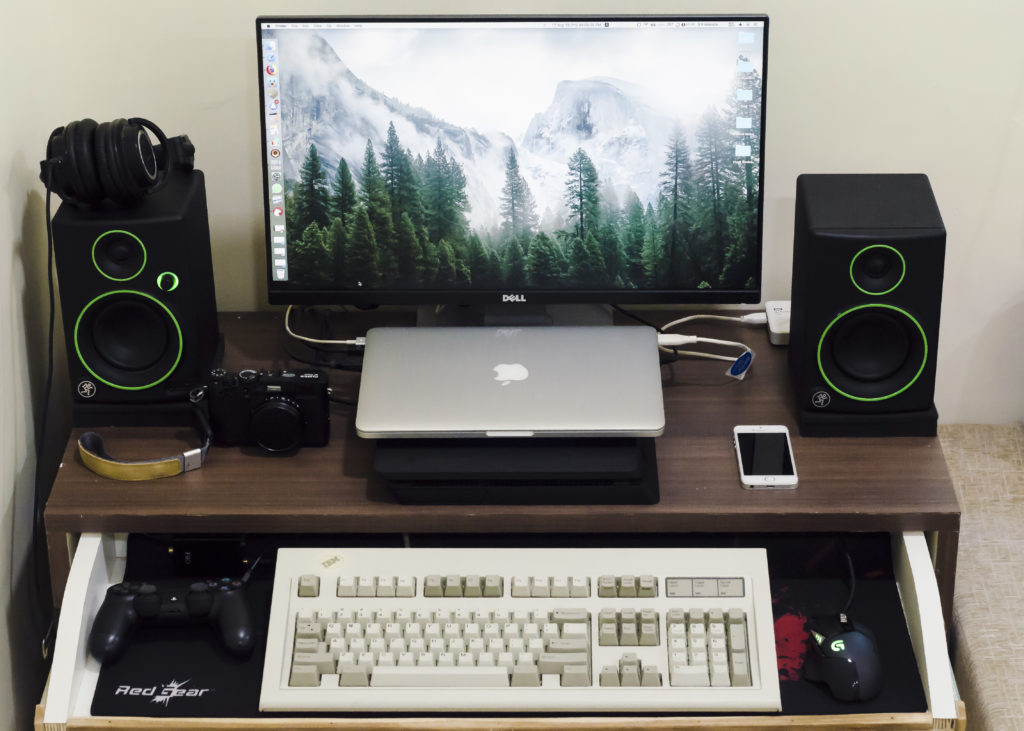
My Current Desktop Setup
Since July 2015, I have been using a 13” Retina MacBook Pro. This machine is a beast. It has not slowed down yet, neither it has gone buggy. This machine is working at full throttle yet today.
I have it connected to a Dell U2414H 24” Full HD monitor. I have been using it since more than 3 years. This screen is gorgeous. When I purchased it, it was more on the costlier side, but it was a quality product at that time too. The cost has faded now, and the quality is still there. Besides, it has multiple display ports and an in-built usb 3.0 hub, which is great for multiple cables and great as well for connecting my MacBook Pro and PS4.
I use “Original IBM Model M” Buckling Spring Keyboard. This thing is a Tank. It is dated 21/08/1991 – Can you believe that this keyboard is as old as me, and still working!? This is the pinnacle of typing, Pure ASMR. Even though this thing is a luxury, this thing is practical, and durable. I won’t be able to settle down for anything less in future for typing.
I use Logitech G502 Gaming Mouse. I never had games on my MacBook Pro. I use it for productivity purpose. It helps me with various macros, which I am able to set via bettertouchtool e.g. I have keys for changing tabs, closing tab, new tab etc. set to various mouse buttons. I can not perform hassle-free without a gaming mouse. This is a must-have thing for me.
For music and audio, I use Mackie CR3 Studio Monitor Speakers. They are crisp and clear. I find them nice. I use Audio Technica M50x as my headphone. It is crisp and clear. No complains, these two things works. A DAC connects both of them.
As a gaming device, I use a PS4. This thing is cool and connected to the same monitor.
There is one more thing which usually is on my desk, it is a Fujifilm X100F Mirrorless Camera. I find this thing aesthetic, a luxury, and a practical camera.
It is a stock macOS wallpaper.
Like hardwares, softwares are the world we live in for a particular work. A world needs to be easy, beautiful, and fun as well, so as every software we use need to be. I choose softwares on these filters.
I always say, my setup will never reach end. To reach end means death. My setup is like a growing organism, it will always evolve. It is always progressively ideal. Whatever I am using is functional and useful at this time. It will keep on evolving in future too. In near future though, I don’t find anything worth upgrading.
This list is gonna be long. You may close the tab and resume your work. I am putting this here so as I could share some good books here. Even though, I read many books, these books stood out to be the best ones.
In this Part II, I want to share my complete interaction with books. I found that systems are the best way to get any work done. May the system be loose or rigid, as necessary for the work. System cuts the crap and makes your work more efficient. I never intended to create system for book reading. It has been evolving with time and experience.
For me reading falls into two categories. Fiction and Non-Fiction. Both are important in their own way.
For non-fiction books, I say reading is learning anything deep enough to understand the core ideas from the experts. When someone writes on a subject, he does his research and organises his thoughts into a book. It takes efforts and lots of thinking & research to write a non-fiction book.
For Fiction, it is very different though. I don’t read to learn anything, I just try to enter into another world. Learning is a byproduct of living that world. Fiction is more flamboyant. There are no boundaries to it. Yet, creating fiction takes lots of efforts. The writer tries to organise his thoughts. It is like taming a wild horse. I say the beauty of a wild horse is in it’s wildness, yet you somehow need enough control on it to appreciate it. Same goes into fictions. Many writers manage to tame that wild horse. It is we who need to let that horse be wild again.
Like reading, this too falls into two categories. Fiction and Non-Fiction.
When I get stuck into anything I never tried, yet I am curious about it, I actively search for books on the subject. I was curious in finding how some things are timeless; I found Perennial Seller by Ryan Holiday. I google book on that topic. I find 4-5 best goodreads.com rating books. I download them and start reading them. If the book impresses me in first 20-30 pages, I continue. Else, I close that book and never read again. I usually get 1-2 books from this process. These 1-2 books fill my information-void enough to know about the topic. If I am too curious, I usually find deep books regarding same topic and repeat the same process.
For fiction, process is a little bit different. I tend to find fiction books from recommendations only. My many RSS feeds help me get the recommendations. I search for goodreads.com rating, read synopsis on goodreads.com, and then start reading the same right away. Like non-fiction, if the book impresses me in first 20-30 pages, I continue. Else, I close that book and never think about it again.
If I love a book, as an appreciation towards the writer, I purchase hardcover from Amazon or a second hand good copy from some other website. I don’t mind good copy secondhand provided it is in a good condition. Hardcover is my priority though.
The first thing I want before sitting to read is not coffee. I want solitude and silence before that. I can not read without solitude. I need my thoughts to rest. Then only I can focus on reading. I think in up front what to read. I don’t just open my Kindle to read anything or I don’t just pick any book to read. Before reading, I clearly have in my mind what to read. I put my phone on airplane mode and then I focus on reading. While reading, I consider three things – I want to understand what the writer wants to say, I want to apply what I am reading to my thinking process, and I take pleasure in how the writer presented the whole concept. In non-fiction, my main focus usually is on the first two, in fiction, I tend to focus on all three.
I don’t highlight everything or anything. I highlight those sentences or paragraphs which I find unique and genuine. What we find unique or genuine depends on ourselves. If my mind comments anything on it, I write that down in margin or in my notebook.
When I sit to read, I tend to concentrate about 60-90 mins, which depends upon the quality of book too. I don’t stress about my reading speed or pages left. Both doesn’t matter. What matters is that you’ve read something that will stay in your hard drive (mind) until it matters.
After reading a book, I let it sit for a fortnight. Then I open it, and type all the highlights I took and notes I wrote. This way I get to revise that book. This process takes time. I do not read that book again for a whole year. I tend to remember a book I read by the season of the year. So next year, when I get that season, that mood, that weather, I subconsciously pick that book again to reread. One thing about rereading though. It takes even more time to reread a book than to read the first time.
What do we do if we buy a new shirt or a new dress? We take great care of it. So as is for books. Books are costly economically. At present, you can have a month’s internet access with unlimited phone calls at merely ₹150. While a paperback book usually costs as little as ₹150 to as much as ₹1500. While same hardcover book usually costs upwards of three times more than paperback form. Even on a Kindle, books cost more than a movie ticket, Kindle’s price apart. That being said, Books are not cheap. And if reading is a hobby, they all cost much more.
So, like that dress, we need to take care of books too.
Even though books cost more economically, the mind it opens has endless value. Books have timeless value. Once you read a book, you have it in your mind for the whole life. Taking care of books and handling them well is a gratitude toward them.
I cover books with transparent covers. I never fold a book in half while reading. I always wash my hands before reading. I never swipe the pages for turning; instead, I turn them with the ends. For my Kindle, I use a neoprene pouch. I clean my Kindle with lightly damp microfibre cloth at a month’s interval. I never share my books with anyone; not because I don’t want to, but instead, people don’t value enough.
Find every flamboyant person, there is one common thread between them. Reading Books. Warren Buffett still reads more than 1000 pages a day. His partner Charlie Munger reads the same. They have been doing this since previous more than 60 years. Steve Jobs, Peter Thiel, Adolf Hitler, Niccolo Machiavelli, and endless people who have had been moving the world read books. Our aim is not to move the world, but to move ourselves. There is a sheer joy in reading, may it be comic books or non-fictions or fictions. I say again, books are timeless. Books add something to your mind. Pointless surfing on internet or changing tv channels only entertain our mind, but they don’t add anything. You may ask what is the use of adding rather than entertaining? I’ll say, we – the homo sapiens – have not evolved because of entertainment, but because of addition. Addition is curiosity, and curiosity is happiness. Look how a child is curious, and so the child is happy; because he is adding something every time.
In my whole life, I have known no wise people (over a broad subject matter area) who didn’t read all the time — none, zero. You’d be amazed at how much Warren reads—and at how much I read. My children laugh at me. They think I’m a book with a couple of legs sticking out.
– Charlie Munger